
Most business websites today rely on a page builder such as Elementor, Beaver Builder, Divi or WPBakery, and they often sit on shared web hosting. We work differently. A custom-built website on AWS, or in another cloud, is our alternative.
We write the site’s design, templates and features as our own code and run it on a dedicated Linux server in the cloud. Most often, we choose the Amazon AWS Stockholm region, but the same set-up works just as well in Microsoft Azure, Oracle Cloud Infrastructure or Google Cloud.
As a result, you get a custom-built website on AWS or in the cloud you already use. It loads faster, has a smaller attack surface and is not bound by any page builder’s limitations.

Why a custom-built website on AWS without a page builder?
A page builder makes it easy to drag and drop blocks, but the convenience has a price. In fact, every page loads the framework’s own CSS and JavaScript files, whether the page uses them or not.
In addition, the tool often adds several layers of wrapping elements around every heading and image. This makes the page code heavy for both browsers and search engines.
Therefore, we only write the code that the page actually needs. A home page from us consists of clean HTML, its own stylesheet and a small script for the animation, and the browser fetches none of it on pages where it has no function.
At the same time, the dependency on a supplier’s licence, update pace and price changes disappears. When you want a new feature, we build it directly into the theme instead of looking for yet another plugin.
In other words, your business decides how the site looks and works, not a template that thousands of other companies already use.
Security: fewer plugins mean fewer ways in
The greatest risk in a WordPress environment rarely sits in WordPress itself. Patchstack’s report on WordPress security counted 11,334 new vulnerabilities during 2025, and 91 percent of them were in plugins, while the core had only a few low-priority flaws.
The report also shows that attackers often start exploiting a new vulnerability within hours. Page builders are no exception.
In August 2026, Elementor fixed a critical vulnerability in Elementor Pro that could allow remote code execution, and the attacks started on the same day as the fix.
Therefore, we keep the number of plugins down to a few carefully selected ones. We review every line of our own code ourselves, and no part of the site waits for a third party to release a security update.
In addition, we remove version numbers and generator tags, so that an attacker cannot directly read which components the site runs.
Speed and search engines
Google measures how fast a page loads and how stable it is while loading. These metrics affect both ranking and how visitors perceive the company.
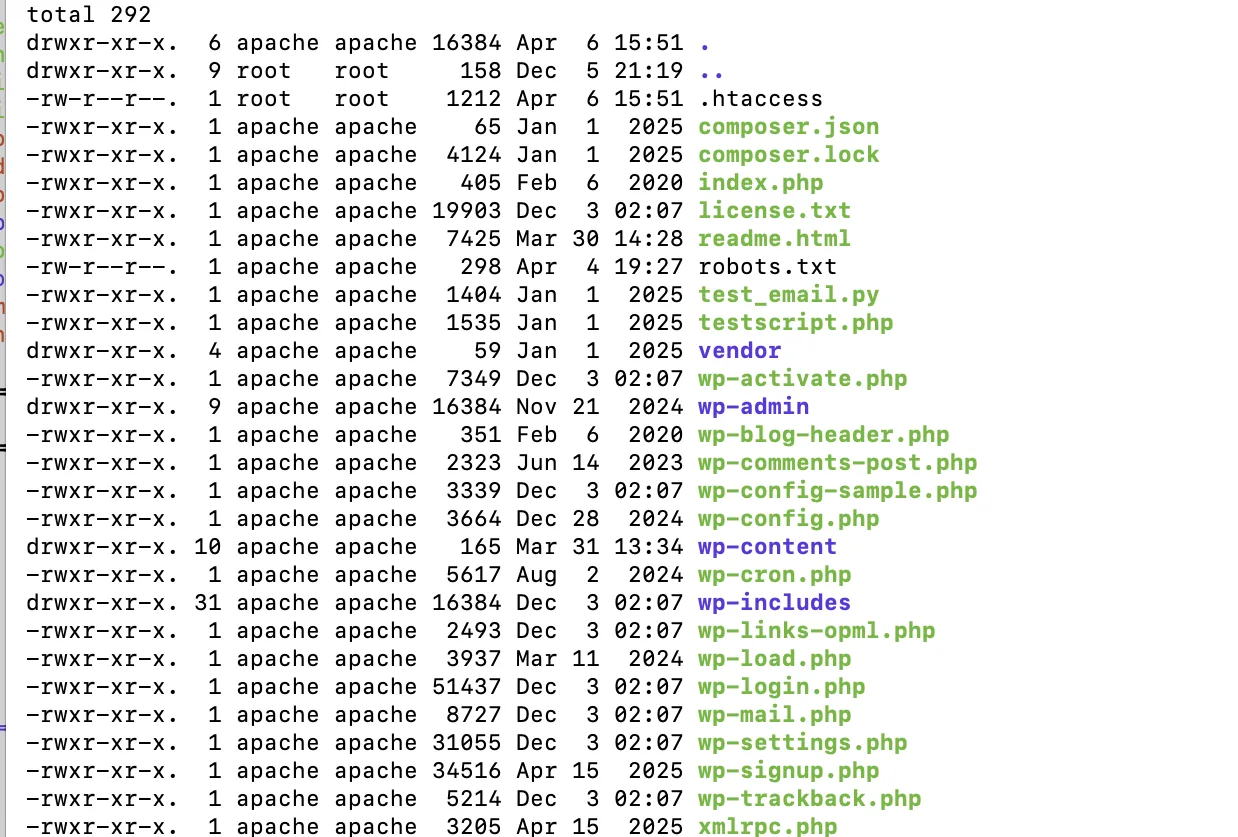
A site without a page builder has far fewer files to fetch, and as a result the main content of the page reaches the screen faster.
We compress images to WebP, load images further down the page only when the visitor scrolls there and place the styles for the first screen directly in the page.
Since the heading structure and the article text sit in the standard WordPress editor, it also becomes easier to work with Yoast SEO and structured data.
A custom-built website on AWS, Azure, Oracle or Google Cloud instead of web hosting
On traditional web hosting, your site shares a server with hundreds of other customers. Consequently, other customers’ traffic, outdated plugins and the host’s limits on memory, PHP version and cache also affect your site.
Instead, we run the site on a dedicated virtual server. In other words, you do not need a web host such as GoDaddy, One.com or Loopia.
Your business decides the choice of cloud. If the group already has agreements and governance in Microsoft Azure, we place the server there.
If you work with Oracle databases, Oracle Cloud Infrastructure may be the right choice, and if you use Google Workspace and BigQuery, Google Cloud may suit better. Moreover, you can move the site between clouds later, since the code and the database are yours.
The server runs Apache, PHP-FPM and MariaDB, which we configure and harden ourselves, with a dedicated firewall, restricted access to the administration and automatic database backups. At the same time, the data can stay in Sweden or within the EU, depending on which region you choose.
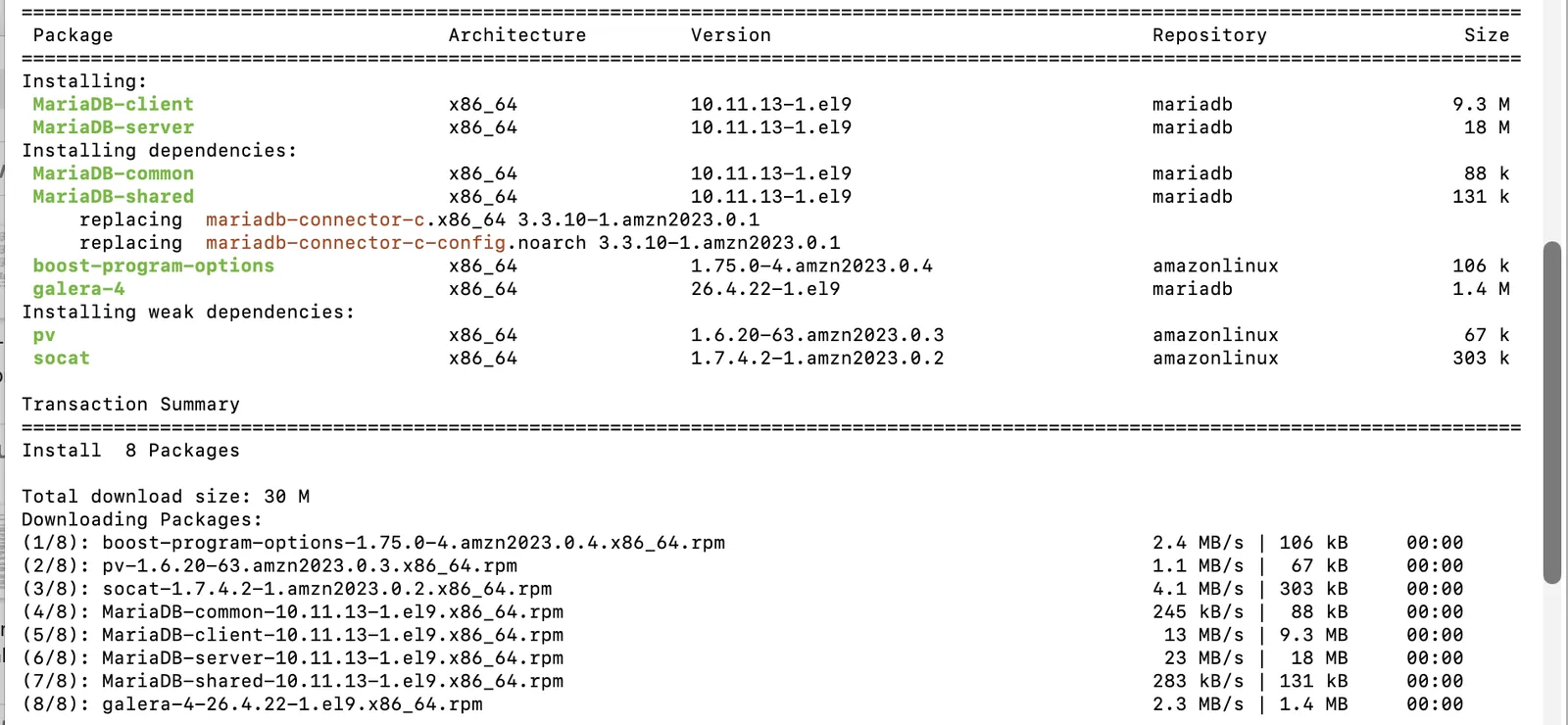
It is worth being clear about one thing. With all four cloud providers, the provider is responsible for data centres and hardware, while responsibility for the operating system, updates and monitoring lies with whoever operates the server.
We take that responsibility, and it is one of the reasons why the sites stay fast and stable over time.
What does operation include?
Operation covers security updates of the operating system and WordPress, monitoring of disk, memory and services, backups, renewal of TLS certificates and action on anomalies.
We also protect files that should never be reachable from the web, for example configuration files, logs and old test files, with rules directly in the web server.
If a service stops, the server restarts it automatically, and we get notified before visitors notice anything. We describe how we work with permissions in the cloud in the article on migration from AWS to Azure.
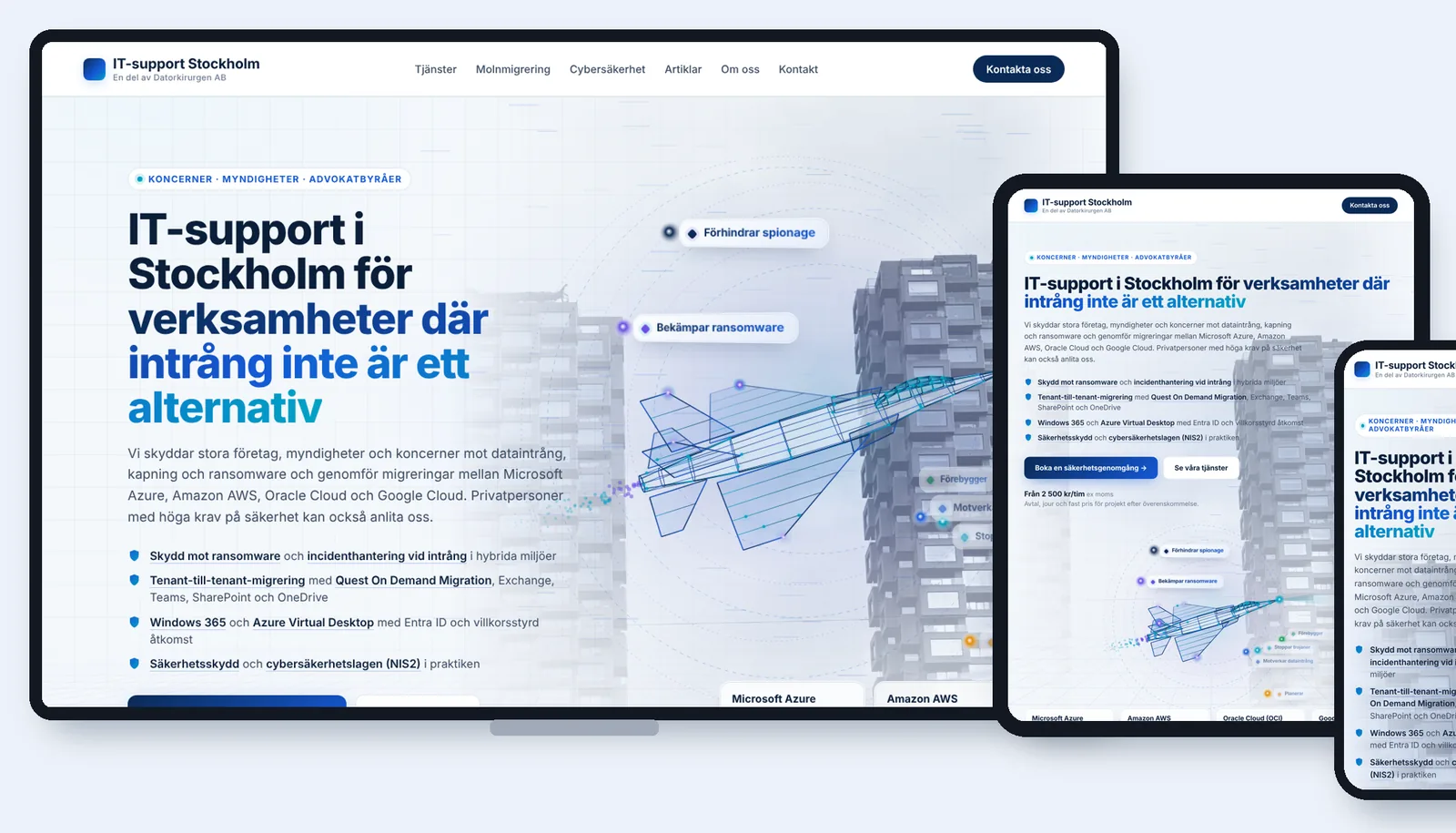
This website is an example of such a project
The site you are reading right now is built exactly this way. It has no page builder, no purchased theme and no shared web hosting.
Instead, it consists of its own theme, its own styles and its own animation in the hero section, and we publish all content with scripts that we can rerun, test and roll back. We run the server ourselves in the AWS Stockholm region.
Therefore, we can also change anything on the site without waiting for a supplier. When we want a new section, a new menu or a new image effect, we write it, test it on desktop, tablet and phone and publish it the same day.
The freedom also applies going forward. No page builder licence expires, no web host raises its prices or shuts down an older PHP version, and no third party decides how the site may look.
What does a custom-built website cost?
A custom-built website on AWS, Azure, Oracle Cloud or Google Cloud, with the same scope as IT-support Stockholm, costs from €19,400 excluding VAT. For example, this applies to a company, a law firm, a travel centre or a medical practice that wants its own design, home page, service pages, articles and contact form.
That is more than a template on web hosting. On the other hand, you get a site that strengthens your brand, loads fast and has a clean code structure that search engines read without detours.
In other words, you give the site better conditions to rank higher and faster in Google. At the same time, it highlights your credibility, since visitors meet a site that looks and works the way you want and not like thousands of others.
For a business where a single new client, a new contract or a few more patients a month are worth more than the investment itself, you often recover the cost quickly. In addition, you avoid the ongoing licence fees for page builders and premium plugins.
In addition to the price of the build itself, there is a service agreement. It covers regular updates, security checks, backups and server maintenance, so that the site stays fast and secure year after year.
How a project works
First, we review what the site should achieve, which target groups it addresses and which keywords matter.
Then we create the design and structure, and you see previews for desktop, tablet and phone before we publish anything.
After that, we build the theme, home page and articles as scripts. This means that every change is repeatable, testable and reversible.
Before publishing, we always back up the database and run a dry run. Finally, we check headings, metadata and image captions against Yoast and submit the sitemap to Google Search Console.
Who is it for?
Above all, the set-up suits groups, public authorities, law firms and other organisations where the website is part of their credibility and where an intrusion would have serious consequences.
It also suits companies, law firms, travel centres and medical practices that have outgrown their page builder and want a faster site that they fully own.
Contact us via the form on our home page, and we will review your current site. New sites from €19,400 and ongoing work from €400 per hour or a fixed price, excluding VAT. IT-support Stockholm is part of Datorkirurgen AB.
Frequently asked questions about a custom-built website on AWS
The technology behind a custom-built website on AWS
- What is a page builder such as Elementor or Beaver Builder?
- Do you build the website in WordPress?
- Can we edit texts and articles ourselves?
- How much faster is a website without a page builder?
- Can the site run in Azure, Oracle Cloud or Google Cloud instead of AWS?
- Where is the server located geographically?
- Can the website have animations without becoming slow?
- Does the website work on phones and tablets?
- Do we own the code of the website?
- Do you use WebP for the images?
Security and operation of a custom-built website on AWS
- Why do fewer plugins make a website more secure?
- How many plugins do you usually use?
- Who is responsible for security on the server?
- How often do you back up the database?
- Do you hide version numbers in the source code?
- Do you protect the WordPress login?
- How do you stop spam in the contact form?
- What happens when someone discovers a vulnerability in WordPress?
- Do you monitor the server around the clock?
- Do you renew the TLS certificates automatically?
- Do you remove old test files from the web root?
- Do we need web hosting alongside AWS?
Price and projects for a custom-built website on AWS
- What does a custom-built website cost?
- Does the price include operation and monitoring?
- How long does a project take?
- Do we get to see the website before it goes live?
- Can you move our existing site without losing rankings in Google?
- Does the set-up suit public authorities and law firms?
- Why does a custom-built website cost from €19,400?
- How do we get started?